Life
We walk this Earth with hearts
grateful or peckish
content or anguished
with minds calculating, worried, or distracted
numbed out or judging—
while behind us for as far
as the eyes can see
stand the ancestors
singing with warm breath
whispering encouragements
hoping one day
we will hear the melody through birch or beech –
The song of creation —
and remember how precious
we are, how fleeting
this life.
Somewhere, beyond Winnie the Pooh’s Hundred Acre Wood, there exists an essence, found only in nature. It’s wild and alive. A resonance you can feel the moment you walk a root-carved forest trail, or scale a rocky mountain, or lower your body into salt waters. When we slow down enough—really giving ourselves the expansiveness of time to absorb it—we feel a deep sense of belonging.
Whether or not we’ve ever put words to it, the cells in our bodies know. We are homesick. We long for the teachings, the guidance, the super-natural allies—found in nature. Most of us have lost the vitality that arises so humbly, so intangibly and so exquisitely from being in deep relationship with nature.
In her book The Enchanted Life: unlocking the magic of the everyday, mythologist and author, Sharon Blackie The Art of Enchantment, with Dr Sharon Blackie) writes about humans’ detachment from the rest of the natural world. “Plato argued 2500 years ago that humans alone possess reason and intellect, and because of this we are not only different from, but superior to, every other creature that exists. There we have it: in one fell swoop we are severed from the rest of life on this planet.”
Atop my writing desk are seed clusters
Carrots, beets, lupine, and milkweed. These seeds contain powerful life force energy inside their protective shells. When seeds come into relationship with fertile soil, warming sun, and enough rainfall, they grow, flower, and fruit, fulfilling what I call their Noble Contribution to a rich, biodiverse and balanced whole.
I call this Wildsong because I believe in the power of singing as a way to weave ourselves back into the world. Some years ago I wrote a song with first lines:
“Nurture the seed in your heart. Tend to its delicate parts. Do like the ancients who knelt in Earth – carefully pruning and urging the blooming.”
— From the original song, “Feed the Tribe”
Most of the time, I write lyrics to live into them. These words were my own heart’s longing for re-connection with what matters most.
I didn’t need an advanced engineering degree to tell me that my work in command-and-control corporate environments was not where my soul would be fed.
However, it would take many years before the seed of my heart’s longing fell onto fertile soil. I was at a retreat given by global activist and healer, Deena Metzger. She had a process whereby she randomly chose one book from the thousands on her shelves, cracked it open to a place in the middle, and read from the page. It was a kind of divination. On this day, she read a poem about a woman who vowed to give her life to save “the last patch of green” that remained on an otherwise degraded and decimated earthen terrain. Hearing the poem, something uncoiled from the deepest reaches of my heart. I felt a rush of energy. I will be her! Were there a single patch of green left, I knew with certainty that I would risk my life for it. I had found my Noble Contribution. Or maybe it had found me.
As an aside, neither Deena nor I can find that poem again. Like the mythical village, Brigadoon, that appears every 100 years out of the mists, the “last patch of green poem” appeared and catalyzed a journey from corporate executive to Earth Ally, and then, apparently disappeared.
Soon I walked away from the shiny penny—or should I say millions of shiny pennies—that was “corporate consulting.” I began peeling back layers and layers of programming to remember the girl who climbed a big willow tree that bordered a golf course behind my family’s home. To remember the girl who carried picnics to secret places alongside a tributary of Ellicott Creek. To remember the girl whose hands felt the slippery kiss of pollywogs at a boggy spot my seven siblings and I called, “down the new road.”
Where could I begin such a massive shift in identity? At the time I was consulting for the Securities & Exchange Commission, as far from natural and green—real green—as I could get. Moreover, despite my engineering degrees, I had no naturalist credentials—no environmental science or botany degree. But here’s what I learned: when a soul begins to align with its purpose, the heart carries superlative qualifications.
While in this interim place—neither executive nor earth ally—my friend, Lawrie, suggested I write a Secret Bio. As if by writing it down, I could create a conjuring spell to bring that future to me.
After writing it, this poem came to me.
At Long Last
At long last
I’ve come out of hiding
a half-century is all
it took
This is no crossroads;
this is a launch pad.
From a cliff?
Into a sea?
Up where the air is clear?
I throw myself into radical uncertainty
Yet I hold onto
something
I hold it lovingly to my breast
A secret bio
with nouns like sanctuary-keeper, way-shower
and storyteller
(that tenderly dislodge other nouns
like engineer, executive, and project manager)
I hold this holy thing as a launch pad
and cast off
everything else.
I began to go outdoors with the intention of listening for guidance. My mind spun its mental distractions. I fidgeted. I wondered: what am I doing out here? Finally, my mind stilled and I began to observe and merge with the landscape.
Wildsong Lesson #1: Slow down to nature’s pace.
I read once that humans live at a frenetic pace compared to the rest of the living world, and by doing so, we forfeit the wise and wondrous input from this living world. By aligning with the rhythm of Earth, we become what Rudolf Steiner calls, “soul-quiet,” and “spirit-calm.” From an inner peacefulness we can gain perspective and new insights.
Sharon Blackie writes, “In most indigenous societies the prevailing view of the world is animistic. The word ‘animism’ derives from the Greek anima, ‘soul’, and in such a worldview everything is alive—not just humans, not just animals, but rivers and seas, rocks and stones, trees and plants. Humans are a part of this world just like all those other living things. We aren’t in charge, and neither are we alienated observers of an inert cosmos; we are all bound up in its unfolding, all of us in it together.”
Ask yourself what space do you create for listening and conversing with the rest of the natural world? If your answer is none, join me if you can for one of my Wild Wonder Forest Bathing walks. You never know what magic can happen, and most certainly peacefulness awaits.
In addition to the enchantment that is possible in wilderness, research has shown the rewards of being in nature are physical, mental, and spiritual. In describing “forest bathing,” Irish Botanist Diana Beresford Kroeger, says, “Some of the most complex chemistry is produced in the furnace of a tree, where antibiotic compounds Alpha-Pinene and Beta-Pinene are emitted, as well as Limonene compound (used in chemotherapy).” All of which provide an immune system boost when we walk through a forest, signaling our bodies and our nervous systems to relax as our heart rate and blood pressure lowers.
The more I slowed down in forests, the more aware I became of the incongruence of life in Western culture. For instance, our definition for success. It seems bass-ackwards, with rewards systems of status, titles, money, minions, and stuff from unsustainable sources. Everything that is not natural. Everything that our intuition would confirm is out of integrity with a nature-based way of living. What Penobscot attorney, Sherri Mitchell calls, the Sacred Instructions encoded in our DNA, waiting to be called forth. In Western society, what gets measured is the easy stuff, what gets valued is the empty stuff.
Wildsong Lesson #2: Redefine what success means.
I learned how to carve out a new definition for success for my life, one that includes placing a higher value on time seemingly “doing nothing” in nature; one that places less value on consumption for its own sake. It is a practice like yoga or meditation; it takes devotion.
I’ve often said, “this business of becoming more conscious is not for the faint of heart.” When one questions the very foundation of our lifestyle—the definition for success— soon, everything else comes up for scrutiny. While deprogramming what has been taken as sacrosanct, I reexamined my definition of beauty.
Wildsong Lesson #3: Redefine beauty—both outer beauty and inner beauty.
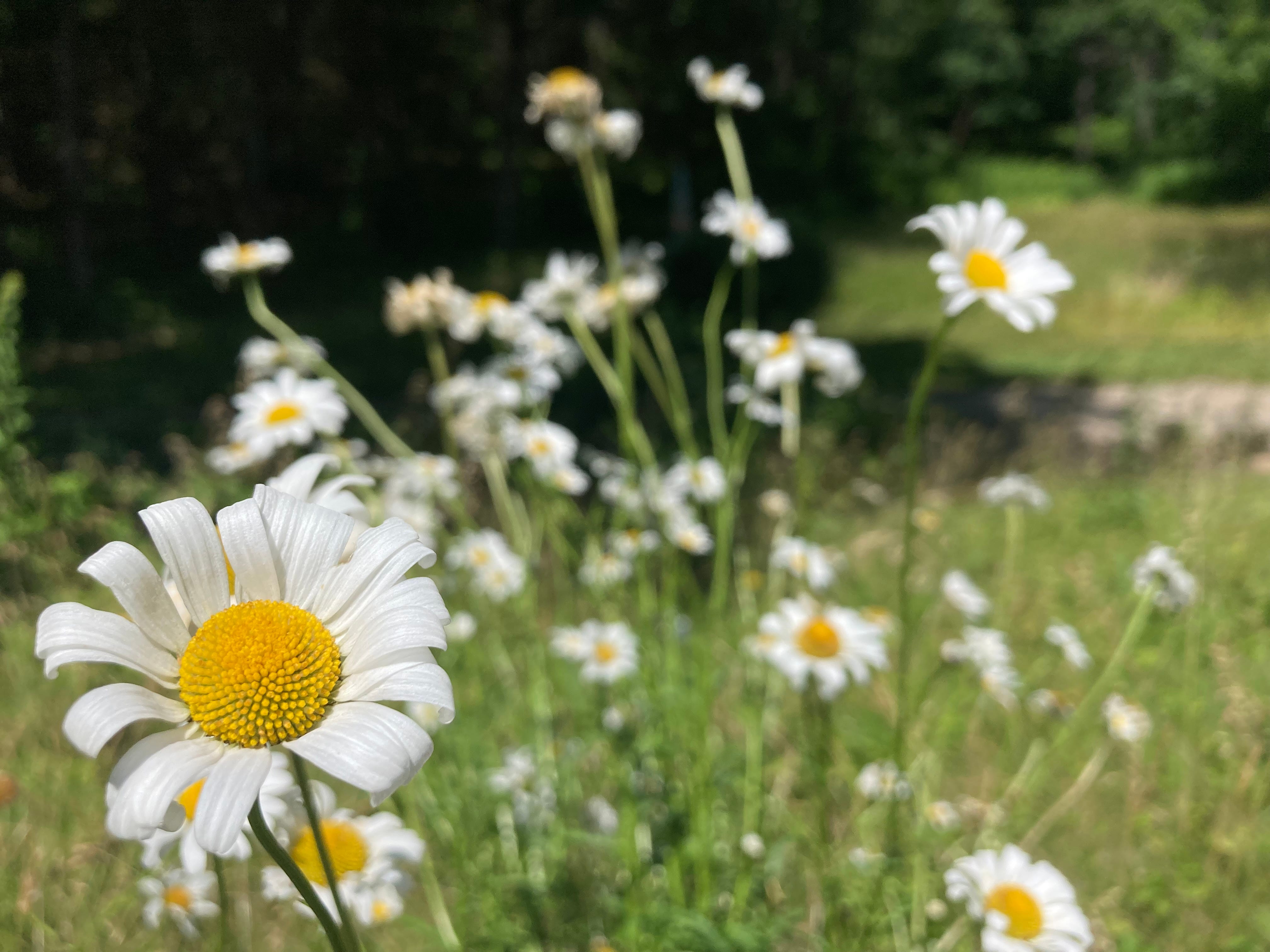
Once I saw weeds as an unworthy part of a garden. Similarly, once I had self-loathing for my own inner “unworthy” parts—like my sensitive, empathic side, devalued in the corporate world as “thin skin.” Imagine the freedom that comes from not having to force your garden to look a certain way; from recognizing that weeds are simply mislabeled wildflowers. Imagine the peace of mind that comes from accepting yourself as a uniquely human being.
On social media, I use the hashtag #naturalisthenewperfect because when we listen to the land’s dreaming, we can discover there is a plant the land already has a propensity to support; often it’s a profusion of native wildflowers or shrubs, which provides food or shelter ideally-suited for native bees, monarch butterflies, or cottontail rabbits, a threatened species. And when we accept that we are humans who are just trying to make our way in the world, flaws in all, life and judgment eases.
Wildsong Lesson #4: Trust that the universe will conspire to support the actions that come from your heart’s deepest longing.
Here’s a story about the beneficent energetic forces of the cosmos: In the same serendipitous way I came upon the “last patch of green poem,” one day I discovered someone was convening a conference called, “Climate Change & Consciousness” in Findhorn, Scotland, a place noted for its deep interconnection with land and sea. Climate Change & Consciousness seemed to recognize that to restore, repair, and rematriate our living earth requires a shift in consciousness. It felt exactly right.
The amphitheater would hold 350 people, with sections apportioned for environmental policy makers (I’m not qualified); indigenous peoples (not qualified); government and NGO leaders (not qualified); educators and activists (maybe qualified)? Artists (a little qualified?) The application was free-form. Tell us why you need to be there.
Words poured from my heart onto the online application. And before I clicked send, I asked One Greater to intervene if my attendance was important to fulfilling my Noble Contribution. Against all odds, 20 minutes after pushing send, my application was accepted. The universe had conspired. Now perhaps it was because I promised to clean toilets, (which I did!) but even now, convener Dr. Stephanie Mines CRONE SPEAK tells me she remembers my application from among the thousands.
Wildsong Lesson #5: Act in reciprocity.
Today, more fully in a stance of Earth Ally than ever, I’m focused on making amends for whatever ways I and my ancestors have contributed to the myriad of psycho-social-economic, cultural, racial and gender inequities that persist today. These injustices can also be called, “Climate Crisis” because they are derived from a mindset that treats OTHER as enemy, less-than, or expendable; a mindset that plunders and degrades nature as a resource instead of a living intelligence that has a limited ability to regenerate. This is reciprocity.
In this portion of my essay, published in A DANGEROUS NEW WORLD: Maine Voices on the Climate Crisis. I write:
The Profound, Paradoxical, and Sacred Gift of These Times
I kneel in a shady garden bed alongside a potted bleeding heart plant I’ve purchased from Three Acres Gardens, one of those garden stands that pops up out of nowhere on a parcel of land repurposed to sell pies and plants to returning tourists and us locals. The air is drenched with the scent of apple blossoms and lilacs, and the sun feels warm, almost hot. Finally.
It has been a long and wet spring, with 21 straight days of rain. A new record. As though Mother Nature is finally showing us compassion, Memorial Day weekend arrives to sunshine and promising moments of bliss.
It’s a small job—planting two bleeding hearts—and afterward, I hope to join my husband who is spreading clover and alfalfa seeds on the lawn we’re transforming from a grass monocrop to a veritable feast for the honey bees in hives nearby. Then I’ll plant more wildflower seeds on the field alongside our house, already rowdy with milkweed, mountain mint, and asters.
As I push the blade of a shovel into mulch-covered soil, I expect it to give way with ease. The soil resists. I try again without success. Then it occurs to me: 18 years ago, I laid fabric to prevent so-called weeds from appearing there. I scrape away mulch, and sure enough, I see a gray, tightly-meshed fabric.
I retrieve a utility knife and manage to hack my way through the cloth. As I yank it up, I notice amid the tangle of roots—worms, more worms than I have ever seen. They’re in between the roots and fine mesh fibers on the cloth, moving. A little. They appear trapped. Or are they? Maybe they’re fine. They look fat. I’m fully aware of the millennia of domination caused by my human species. I’m unsure what is the “right action.” I send a little prayer from my heart: help me know what is right here. I lift the cloth, observe the worms.
“I’ve never seen so many worms before,” I murmur. Then an inner voice rasps, You’ve never seen so many worms because they’re all stuck. A gut-punch. All those years ago when I purchased this fabric, I was a different woman, with a different level of consciousness. Trapped in a fast-paced corporate executive job that I hated, my goal was simple: I wanted a Pretty. Perfect. Garden. With no weeds.
Now, I sit back on my haunches and consider the worms. It’s clear they are getting enough food. But a worm’s noble contribution to an ecosystem is to aerate the soul. They cannot fulfill their role in an interconnected whole if they cannot move. Nor can they rise to the surface when it rains, providing food for robins.
Suddenly I realize how one treats her worms is how one treats all life. It makes no difference whether it is a worm or a whale. “Oh my god, I am so sorry,” I say to those worms. “I laid that cloth. I did not look upon you as important. And it’s my fault.”
I now know the right action, to return earthworms to Mother Earth. Ever so gently, I begin to extract them from their stuck place between fabric and roots, at times having to use the knife to cut away fibers. Perhaps some would call me insane. I work for hours and hours. Nothing seems so important. I am making amends for all those years of unconscious indifference to a worm’s plight.
When we deprogram the ingrained story of “the other” and align ourselves with the life force of the planet, unimagined miracles are possible. Thus, amid the often paralyzing bad news, I realize the paradox and the gift of these times: any act, no matter how small, if done in love, can shift the consciousness necessary to bring about new solutions to climate crisis and a new interconnectedness in our world. We don’t have to move mountains. We only have to move ourselves in the direction of healing and love, starting close-in.
As close in as these worms are—dozens and dozens of them—now moving slowly into life-giving soil. With care, I push the mulch back into place, and as I do so, my hands come upon a rough, heart-shaped stone. A sign from Great Mother. I clutch it to my heart.
I close by asking: what’s the more that can arise in you when you deepen your relationship with the rest of the natural world? What can you offer that aligns with your heart’s longing? Go. Do that.
Returning full circle, the chorus to Feed the Tribe says:
Grow, blossom, and grow. Grow these seeds we have sewn. Feed the Tribe.
Make each strong inside.
May the Wildsongs within you grow and flourish.